8594, Dixie Highway, Louisville, KY 40258
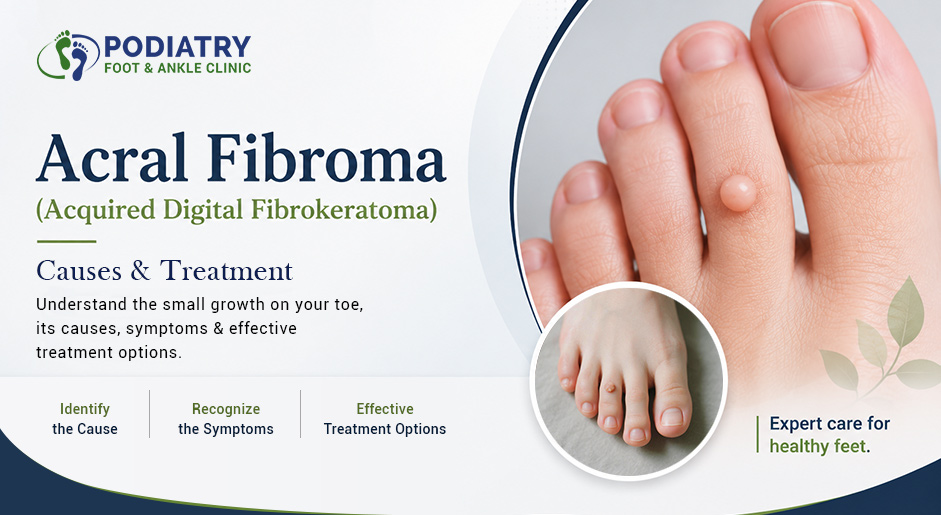
Acral Fibroma (Acquired Digital Fibrokeratoma)
Have you recently noticed a small bump on your toe that doesn’t seem to go away? It may not be painful, but it’s enough to make you wonder if it’s something serious.
Many people assume any new growth on the foot is a wart, corn or callus. However, not every skin growth is caused by friction or infection. In some cases, that small bump could be an Acral Fibroma, also known as Acquired Digital Fibrokeratoma.
Although the name sounds intimidating, this condition is non-cancerous and is usually easy to treat when diagnosed early.
At Podiatry Foot & Ankle Clinic, Dr. Krishna Gathani evaluates and treats many types of skin and soft tissue growths affecting the feet and toes. Understanding what an Acral Fibroma is and knowing when to seek medical attention can help you avoid unnecessary discomfort and receive the right treatment.
What Is an Acral Fibroma (Acquired Digital Fibrokeratoma)?
An Acral Fibroma is a small, benign soft tissue growth that usually develops on the fingers or toes. In podiatry, it is most commonly found on the toes, especially around the second toe or areas exposed to repeated rubbing.
Unlike warts, Acral Fibromas are not caused by a virus. They are made up of fibrous tissue and typically grow slowly over time.
These growths often appear as:
- A small flesh-colored bump
- Smooth or slightly rough surface
- Firm but flexible texture
- Round or dome-shaped appearance
Because they grow gradually and are usually painless, many people ignore them until they begin rubbing against shoes or become irritated during daily activities.
Is a Small Growth on Your Toe Always a Wart?
Not necessarily.
A wart is caused by the human papillomavirus (HPV), while an Acral Fibroma is a completely different condition.
Although they may appear similar at first glance, they require different treatment approaches.
Many patients attempt to treat these growths with over-the-counter wart removers, only to find that the bump never disappears. This is one of the main reasons why professional evaluation by a podiatrist is important.
What Causes an Acral Fibroma to Develop?
The exact cause of Acral Fibroma is still not completely understood. However, researchers believe repeated irritation or minor trauma may play a role in its development.
Common contributing factors include wearing tight shoes, repeated friction against the toes, pressure from certain types of footwear or previous minor injuries to the area.
Some Acral Fibromas develop without any obvious cause, making professional diagnosis even more important.
What Are the Symptoms of an Acral Fibroma?
Many Acral Fibromas cause very few symptoms during the early stages. As they become larger, however, they may begin interfering with comfortable footwear or walking.
You may notice:
- A small flesh-colored growth on the toe
- A firm lump that slowly increases in size
- Irritation from shoes or socks
- Mild tenderness after prolonged walking
- Occasional bleeding if repeatedly rubbed
Unlike infections, these growths rarely produce redness, warmth, or drainage.
Where Does an Acral Fibroma Usually Appear?
An Acral Fibroma can develop on any toe, but it most commonly appears on the second toe. It may also occur around the nail, on the top of the toe or near areas that experience frequent pressure from footwear.
Although less common, similar growths may also appear on the fingers.
Is an Acral Fibroma Dangerous?
One of the biggest concerns patients have is whether the growth could be cancerous.
The good news is that Acral Fibroma is considered a benign condition. It does not spread to other parts of the body and is not a type of skin cancer.
However, that doesn’t mean every toe growth should be ignored.
Some skin cancers, cysts, soft tissue tumors and other conditions can resemble an Acral Fibroma. That’s why every new or changing growth should be evaluated by a foot and ankle specialist.
How Is an Acral Fibroma Diagnosed?
Diagnosis usually begins with a physical examination.
Dr. Krishna Gathani will evaluate the size, shape, location and appearance of the growth while discussing your symptoms and medical history.
If the lesion appears unusual or has changed rapidly, removal may be recommended so the tissue can be sent to a pathology laboratory for confirmation.
This helps ensure the diagnosis is accurate and rules out other conditions.
Can an Acral Fibroma Go Away on Its Own?
Unfortunately, Acral Fibromas rarely disappear without treatment.
While some remain stable for years, others continue growing slowly and become more noticeable over time.
If the growth causes discomfort, catches on footwear, or affects your daily activities, professional treatment is usually the best option.
How Is an Acral Fibroma Treated?
The most effective treatment is complete surgical removal.
This is typically performed as an outpatient procedure using local anesthesia, allowing patients to return home the same day.
Removing the growth from its base helps reduce the chance of recurrence and allows the tissue to be examined by a pathology laboratory.
The procedure is generally quick, and most patients experience only minimal discomfort afterward.
Can an Acral Fibroma Come Back?
The recurrence rate is very low when the lesion is completely removed.
Following your podiatrist’s post-operative instructions and attending follow-up appointments can help ensure proper healing and reduce the likelihood of recurrence.
Expert Toe Growth Treatment at Podiatry Foot & Ankle Clinic
If you’ve noticed a persistent bump on your toe or are unsure whether it’s a wart, corn or another type of skin growth, Dr. Krishna Gathani can help.
At Podiatry Foot & Ankle Clinic, we provide comprehensive evaluation and treatment for benign and complex foot conditions, including Acral Fibroma, soft tissue masses, plantar warts, cysts and other toe lesions. Our goal is to provide an accurate diagnosis, effective treatment and long-term relief so you can get back to walking comfortably.
Frequently Asked Questions (FAQs):
What is an Acral Fibroma on the toe?
An Acral Fibroma is a non-cancerous soft tissue growth that usually appears as a small, firm bump on the toes or fingers. Although it grows slowly, it should be evaluated by a podiatrist to confirm the diagnosis.
Is an Acquired Digital Fibrokeratoma the same as a wart?
No. Unlike a wart, an Acquired Digital Fibrokeratoma is not caused by a virus. While the two may look similar, they require different treatment approaches.
Can an Acral Fibroma become cancerous?
No. An Acral Fibroma is considered a benign growth and does not become cancerous. However, any new or changing skin lesion should be examined by a healthcare professional to rule out other conditions.
Does an Acral Fibroma need to be removed?
Removal is recommended if the growth causes pain, irritation, continues to grow, or interferes with walking or wearing shoes. Your podiatrist can determine whether removal is the best treatment option.
How does Dr. Krishna Gathani treat an Acral Fibroma?
Dr. Krishna Gathani performs a thorough evaluation to confirm the diagnosis. If needed, the lesion can be removed using a minor outpatient procedure, and the tissue may be sent for laboratory analysis to ensure an accurate diagnosis.
What happens if I ignore a small bump on my toe?
While many toe growths are benign, they can become larger, irritated, or uncomfortable over time. Some conditions that resemble an Acral Fibroma may require different treatment, making early evaluation important.